Archives for October 2013

Pelican Imaging’ Processing Challenges

Image Sensors World        Go to the original article...

Qualcomm Media publishes Purnam Sheth, Pelican Imaging' VP of Engineering, video story on computational challenges of multi-array camera:


Another video at Qualcomm's site presents Arcsoft's NightHawk low-light video capture software that improves video in poor lighting conditions. "By only using the CPU, NightHawk would not be able to run in real time since the frame rate would be too low, not to mention that the power consumption would be too high. By using the CPU, GPU, DSP and ISP, ArcSoft claims that the NightHawk application is able to run in real time with more than 30% power savings."

Go to the original article...

Image Sensors for EUV Photolithograthy

Image Sensors World        Go to the original article...

Extreme UV photolithoraphy challenges extend to image sensor design for mask and wafer inspection. KLA-Tencor's patent application US20130264481 "Back-illuminated sensor with boron layer" by Chern Jehn-Huar, Ehsani Ali R., Delgado Gildardo, Brown David L., Chuang Yung-Ho Alex, and Fielden John gives a nice overview of these challenges:

"Inspection systems are typically in use 24 hours per day with only short stoppages, the detectors are exposed to large doses of radiation after only a few months of operation.

A photon with a vacuum wavelength of 250 nm has energy of approximately 5 eV. The bandgap of silicon dioxide is about 10 eV. Although it would appear that such wavelength photons cannot be absorbed by silicon dioxide, silicon dioxide as grown on a silicon surface must have some dangling bonds at the interface with the silicon because the silicon dioxide structure cannot perfectly match that of the silicon crystal. Furthermore, because the single dioxide is amorphous, there are likely also some dangling bonds within the material. In practice, there will be a non-negligible density of defects and impurities within the oxide, as well as at the interface to underlying semiconductor, that can absorb photons with deep UV wavelengths, particularly those shorter than about 250 nm in wavelength. Furthermore, under high radiation flux density, two high-energy photons may arrive near the same location within a very short time interval (nanoseconds or picoseconds), which can lead to electrons being excited to the conduction band of the silicon dioxide by two absorption events in rapid succession or by two-photon absorption. EUV photons have very high energies (13.5 nm in wavelength corresponds to photon energy close to 92 eV) and are capable of breaking silicon-oxygen bonds as well as strongly interacting with defects and contaminants in the oxide. Electron and charged-particle detectors typically have to detect electrons or charged particles with energies of a few hundred eV or higher. Energies greater than 10 eV can readily break silicon-oxygen bonds.

As indicated above, high-energy photons and particles can break bonds and ionize atoms in a silicon dioxide layer. Because silicon dioxide is a good insulator, free electrons created in the silicon dioxide may have lifetimes of ms or longer before recombining. Some of these electrons may migrate into the semiconductor material. These electrons create electric fields within the silicon dioxide and between the silicon dioxide and semiconductor. These electric fields can cause electrons created in the semiconductor by absorption of photons to migrate to the surface of the semiconductor and recombine, thereby resulting in lost signal and reduced detector quantum efficiency. Near continuous use of the instrument means that there may be little, or no, time for recovery of the detector, as new free charges are created as fast as, or faster than, they can recombine.

High-energy particles and photons can also cause irreversible changes to the silicon dioxide. Such changes can include reconfiguration of the bonding of atoms or migration of small atoms within the silicon dioxide. At normal operating temperatures of the detector, which are typically in a range from around room temperature to about 50° C., these changes will not recover. In particular, it is known that conventional silicon photodiodes used as EUV detectors degrade in efficiency with use.

The silicon dioxide layer on the surface of semiconductor detectors significantly reduces the efficiency of those detectors for low-energy (less than about 2 kV) electrons. Some low-energy electrons are absorbed by the silicon dioxide, thereby causing the silicon dioxide to charge up and deflect subsequent arriving electrons. Because a native oxide will always form on an exposed silicon surface, silicon detectors necessarily must have some oxide on their surface. Growing or depositing an alternative dielectric material (instead of the oxide) on the surface of the semiconductor results in a much higher density of defect states at the semiconductor to silicon dioxide interface. These defects reduce the quantum efficiency of the detector, especially for photons or charged particles absorbed close to the surface of the semiconductor.
"

The proposed solution is to use BSI sensor with pure boron deposited on the backside to form a shallow pn-junction. The metallic boron layer effectively shields the junction from all surface defects that might exist in the oxide or AR coating on the back surface:

Go to the original article...

Daala Promises Better Efficiency than H.265

Image Sensors World        Go to the original article...

It came to my attention that an open source project Daala is developing a royalty-free video codec claimed to have better efficiency than the recently adopted H.265:

"Daala is a new general-purpose video codec currently under development at Xiph.Org. Our performance target is roughly a generation beyond current 'next-generation' codecs like VP9 and HEVC, making Daala a next-next-generation effort. As with other Xiph codecs, the Daala format is and will always be royalty-free with a permissive FOSS license. On May 30th 2013, our in-development Daala prototype encoded and decoded its first streams. Two hours later, Mozilla's David "oneman" Richards streamed the first live Daala video over the Internet."

Go to the original article...

Image Processing Speedup on ARM GPU

Image Sensors World        Go to the original article...

ARM Blog published a guest post by Japan-based Synthesis Corporation optimizing its image processing IP for ARM Mali-T600 GPU. The two examples are super-resolution and HDR, both showing a significant speedup:


Synthesis also demos its real-time HDR video capabilities in this Youtube video:

Go to the original article...

Omnivision Announces OmniGlass Reference Design

Image Sensors World        Go to the original article...

PR Newswire: Omnivision announces OmniGlass reference design that combines a wearable display and a camera module: an ultra-compact and low-power OVP2200 liquid crystal on silicon (LCOS) solution, a 4MP AF camera module with 720p HD video, and the OVP921, a companion chip that provides image processing, Bluetooth, and Wi-Fi support.

A prototype of OmniGlass is currently available for demonstrations, and a development kit is available for customer sampling upon request. The OVP2200 is currently sampling, with volume production expected to begin during Q2 2014.

Go to the original article...

Semiconductor Genome Sequencing Review

Image Sensors World        Go to the original article...

Biomics, a Russian Academy's of Science Journal on Biochemistry and Genetics, published an article on Ion Torrents pH-sensor-based genome sequencing history and progress:

"Rothberg Sequencing (Potential For Semiconductor Sequencing)" by Vladimir V. Zubov, Institute of Theoretical and Experimental Biophysics of RAS, Russia (see pdf link for download)

The article goes through the Ion Torrent genome sequencing machine generations, and talks about the recent developments of the company's pH-sensor. The pH-pixel size has shrunk down to 1.25um now and continues shrinking, while resolution went up to 13MP. The price of full human genome sequencing is expected to drop to $1000 in 2014, in part due to the higher resolution pH-sensor chips: 660MP Ion PII and 1.2GP Ion PIII.

Go to the original article...

Nobukazu Teranishi Won J.J. Ebers Award

Image Sensors World        Go to the original article...

Nobukazu Teranishi won 2013 IEEE Electron Device Society J.J. Ebers Award "For development of the Pinned Photodiode concept widely used in Image Sensors". Congratulations, Nobu-san!

Thanks to EF for letting me know!

Go to the original article...

Panasonic Lumix GX7 review – a small but powerful system camera for enthusiasts!

Camera Labs and DSLR Tips latest news and reviews        Go to the original article...

Panasonic's Lumix GX7 is a mirrorless system camera aimed at enthusiasts who demand lots of control and features in a smaller form factor. The GX7 is a little larger than the GX1 it replaces, but squeezes in a tilting EVF with a 2.76 million dot resolution along with a tilting 3in touchscreen. There's built-in Wifi, NFC, focus peaking, a fastest shutter of 1/8000, and 1080p video with full manual exposure control. The resolution remains 16 Megapixels but in a surprise move, it's mounted on a shifting platform to deliver in-body stabilisation to any lens you attach. This all makes the GX7 one of the best-featured system cameras around, but how well does it work in practice? Find out in my in-depth Panasonic Lumix GX7 review, where I've compared it to the Lumix GX1 and G6, the Olympus OMD EM5 and EM1 and finally, the Sony NEX 6!

Go to the original article...

Image Sensors at IEDM 2013

Image Sensors World        Go to the original article...

IEDM 2013 program has been published and has just two papers on image sensors:

27.3 High Performance Amorphous Metal-Oxide Semiconductors Thin-Film Passive and Active Pixel Sensors
R. Zhang, L. Bie, T.-C.Fung*, J. Kanicki, University of Michigan, *Qualcomm MEMS Technologies, Inc.

"In this paper, for the first time, we report on high performance a-IGZO TFTs based passive pixel sensor (PPS) and active pixel sensor (APS) circuits. Experimental results show that single-TFT PPS with a pitch length of 50µm achieved a signal charge gain approaching to unity (Gain=0.93) under a fast readout time of 20µs and a dynamic range of 40dB. APS based on three a-IGZO TFTs established a high dynamic range, which is more than 60dB. In addition, 2-TFTs half active pixel sensor (H-APS) testing circuits are also used to investigate the voltage gain properties for APS in this work."

27.4 Three-dimensional Structures for High Saturation Signals and Crosstalk Suppression in 1.20 µm Pixel Back-Illuminated CMOS Image Sensor
T. Shinohara, K. Watanabe, S. Arakawa, H. Kawashima, A. Kawashima, T. Abe, T. Yanagita, K. Ohta, Y. Inada, M. Onizuka, H. Nakayama, Y. Tateshita, T. Morikawa, K. Ohno, D. Sugimoto, S. Kadomura, T. Hirayama, Sony Semiconductor

"We present three-dimensional structures, vertical transfer gate and buried shielding metal that can be applied to our latest 1/2.3” 1.20um 20M pixels back-illuminated CMOS image sensor. New pixel design and process exhibited 60% higher saturation signals and 50% lower crosstalk without any degradation in white blemish and dark current."

Go to the original article...

MIPI M-PHY 3.0 Spec Ready

Image Sensors World        Go to the original article...

Reuters: MIPI Alliance announces the availability of new version of its M-PHY specification. The M-PHY 3.0 doubles the current bandwidth (to 6.0Gbps per lane) while retaining the same distance reach as its predecessor. It also maintains the MIPI Alliance mobile priorities of low power, minimal protocol impact (modularity), and fast transitions between power states.

PRWeb: Arasan is quick to announce the availability of the industry’s first MIPI M-PHY 3.0-compliant IP. "We have been licensing the Arasan M-PHY analog IP for customers’ mobile application processor and memory applications for more than 18 months," stated Andrew Haines, Arasan's VP of Marketing. However, it remains to be seen if and when M-PHY is adapted in camera modules:

Go to the original article...

Samsung Galaxy Note 3 Features Latest Sony Stacked Sensor

Image Sensors World        Go to the original article...

Chipworks reverse engineered Samsung Galaxy Note 3 and found that its 13MP primary camera uses the latest generation of Sony stacked image sensor, the IMX135. Sony moved all the electronics to the bottom logic chip, so that the sensor's area is barely larger than the pixel array:

IMX135 Die
IMX135 TSVs

It's quite similar to iPhone 5s 8MP Sony ISX014 sensor, too having very little area overhead:

iPhone 5s primary sensor die

Go to the original article...

Samsung Invests in Structured Light 3D Imager Startup

Image Sensors World        Go to the original article...

Haaretz: Samsung invests an undisclosed amount in Mantis Vision, an Israeli startup developing structured light 3D cameras. The older product of the company is shown in this Youtube video:


Update: PrivateEquity.com reports that Samsung's new investment fund is expected to invest in activities that touch on those of Samsung R&D center in Israel, which deals with the development of mobile hardware technology and hardware components for cameras.

Go to the original article...

Canon PowerShot SX510 HS review – one of the first in-depth reviews of Canon’s 30x super-zoom!

Camera Labs and DSLR Tips latest news and reviews        Go to the original article...

Canon's PowerShot SX510 HS is a small and affordable super-zoom with a 30x optical range that starts at a respectably wide 24mm equivalent. It's the successor to the best-selling SX500 IS which struck a compelling balance between pocket super-zooms and larger DSLR-styled models. Canon's swapped the 16 Megapixel CCD from the old model for a higher sensitivity 12 Megapixel CMOS which can also capture Full HD 1080p video, and has also equipped the camera with Wifi for wireless image transfer and remote control. In our Canon SX510 HS review we've compared it against the 30x Nikon COOLPIX L820 to help you choose the best super-zoom camera!

Go to the original article...

Bacterial Imager Proposed

Image Sensors World        Go to the original article...

Petapixel, Phys.org: University of Exeter, UK students present a project called "Paint By COLI". The team attempt to modify E.coli bacteria with light sensitive and pigment production genes, in order to produce a full color biocamera. Bio-Photography is the application of genetically engineered bacteria to act as the light sensor of a camera, replacing digital sensors or photographic film. The surface area of bacteria is on the order of microns, so the resolution should be quite competitive with the current cameras. Individual bacteria functions would be geared for certain wavelengths — red light would stimulate production of cyan pigment, green light for magenta pigment and blue light for yellow.

The project is currently supported by The University of Exeter Annual Fund, CLES, CEMPS and academics from across the University. The group is going to present the project at the Genetically Engineered Machines (iGEM) event in Lyon, France on Oct. 11-13.

Go to the original article...

Crosstalk Reduction Between Multiple Structured Light Cameras

Image Sensors World        Go to the original article...

Microsoft Research posted its paper from CHI'12 conference "Shake’n’Sense: Reducing Interference for Overlapping Structured Light Depth Cameras" by Alex Butler, Shahram Izadi, Otmar Hilliges, David Molyneaux, Steve Hodges, and David Kim.


"The key behind Shake‟n‟Sense is to minimally vibrate a Kinect camera unit using an offset-weight vibration motor and thereby artificially introduce motion blur. Both the structured light DOE illuminator and the IR camera of the Kinect will move in harmony, which means that depth sensing works as normal, albeit with a little induced blur. However, even minor almost imperceptible motion of the sensor in this way causes blurring of structured light patterns from other units which serves to eliminate most of the crosstalk."

Update: It looks like University of North Carolina researchers proposed the same technique at about the same time.

Go to the original article...

Oppo is First to Use Tessera’s MEMS AF

Image Sensors World        Go to the original article...

Business Wire: Tessera's DigitalOptics Corporation (DOC) announces today that Guangdong Oppo Mobile Telecommunications Corp. has placed the first mems|cam volume production purchase order. "We are proud to announce that OPPO and DOC are exclusive launch partners. OPPO will be the first smartphone OEM to incorporate mems|cam products in volume," stated John Thode, president of DigitalOptics Corporation. "OPPO has an excellent premium brand in China as demonstrated by the September 23 launch of the innovative N1 Smartphone platform. Integrating mems|cam modules into OPPO’s best-in-class smartphones will bring an exciting computational imaging user experience that further delivers on OPPO’s brand promise."

There has been speculation on who would be the first to bring the significant benefits of mems|cam to the mobile imaging market. Last week, several technology news blogs reported that mems|cam was first being brought to market in another smartphone platform (Google Nexus 5). Those reports were inaccurate.

Forbes quotes China Morning Post publishing that Oppo's total production is expected to be about 15M phones this year.

Go to the original article...

European IR Sensor Industry Consolidates

Image Sensors World        Go to the original article...

Less than a year ago France-based Sofradir acquired Quantum Well-Infrared Photodetector (QWIP) and InGaAs sensor vendors. Now Sofradir and Onera announce an agreement to transfer Onera’s thermal imaging research group to Sofradir, together with a five-year project aimed at developing disruptive technologies in infrared detection in order to provide OEMs with more highly advanced capabilities in thermal imaging.

"Sofradir and Onera are collaborating once again to break down the technological barriers in infrared by exploring new possibilities in optical integration and other techniques," said Philippe Bensussan, chairman and CEO of Sofradir. "Onera is known for its vision, vast knowledge and expertise in aerospace and defense system design. We are excited about leading future developments in IR detection. We have high expectations about what these advantages will bring to our customers who design optronics systems for defense, space and commercial applications."

The project involves transferring emerging technologies and know-how from Onera, making them ready for industrial processing. The team will carry out research on and develop new techniques for infrared detectors, such as integrated optics, greater compactness, improved functionality and performance of thermal imaging equipment.

Go to the original article...

Silicon File and Dual Aperture to Cooperate on 3D Gesture Tracking Sensor

Image Sensors World        Go to the original article...

PRNewswire: Silicon File announces its collaboration with Dual Aperture, Inc., a Silicon Valley startup, to build a new type of CMOS image sensor that can take sharp pictures, significantly reduce noise, and capture real-time distance information. Furthermore, all of this is possible while utilizing a single, low-power, small form factor sensor instead of stereoscopic sensors, a common feature of most 3D cameras in the marketplace today.

Dual Aperture's image sensor technology relies on 4-color sensor design. The 4-color sensor is comprised of RGB and IR pixels, instead of the traditional Bayer pattern. The sensor uses two separate apertures, one for the RGB spectrum and the other for the IR spectrum, to simultaneously capture two distinct images with different sharpness levels.

Silicon File Technologies will incorporate Dual Aperture's 4-color sensor technology, related image processing algorithms, and various application software into their sensors and sensor module products. These technologies will enable the following features:

  • Reconstruction of color imaging from a 4-color pattern sensor
  • Noise reduction and image sharpening
  • Accurate depth estimation of objects captured in real-time
  • Real-time touch refocusing of pictures
  • Real-time 3D image pair generation
  • Accurate gesture tracking using a low-power, single sensor

"Dual Aperture's technology will enable new dimensions in photography with a multi-purpose camera that uses a low cost, low power, single CMOS image sensor," says Do Young Lee, CEO of Silicon File. "We are thrilled to be the first to partner with Dual Aperture in the growing market that Dual Aperture's 4-color sensor technology has created."
David D. Lee, CEO of Dual Aperture also adds that "Dual Aperture is looking forward to working closely with Silicon File Technologies to develop commercial products targeted for various platforms based on our new ideas and Silicon Files' strong design capabilities. Because of its small form factor and low power usage, Dual Aperture's 4-color sensor technology can be used in a variety of consumer devices, including smart phones, tablets, PCs, TVs and automobile applications."

Under the agreement, Silicon File and DA will work closely together to equip other camera OEMs with new multifunctional cameras. Silicon File will also manufacture and market 4-color sensors and camera modules integrated with new features enabled by DA algorithms.

Dual Aperture apparently does not have a web site. So far USPTO published two Dual Aperture's patent applications, while WIPO lists 7 applications filed in different countries.

Application US20130033579 named "Processing Multi-Aperture Image Data" shows details of the company's technology. The 3D depth imaging part of it is explained below:

Go to the original article...

Workshop on CMOS Image Sensors for High Performance Applications

Image Sensors World        Go to the original article...

CNES, ASTRIUM, THALES ALENIA SPACE, SODERN are organizers of the 3rd workshop "CMOS image sensors for high performance applications" to be held in Toulouse, France on November 26-27, 2013. The preliminary program includes:

CMOS sensors for space applications:
  • Nick Nelms, ESA
    An overview of ESA supported Visible and NIR CMOS Image Sensor development
  • Jérôme Pratlong, e2v
    MTG FCI Visible Detector design and development.
  • Weng-Lyang “Bill” Wang, CMOS Sensor Inc
    Five bands of CMOS Sensor (C468) for Formosat-5
  • Michel Bréart de Boisanger, EADS Astrium
    CMOS Image Sensors optimized for GEO observation
  • Fabien Malbet, IPAG
    Detector requirements for high accuracy astrometry and results of an interferometric detector calibration method
Low flux:
  • Franck Robert, Photonis
    Photonis complementary Digital Solutions for Low Light Level and extreme low light Vision conditions
  • Ajit Kumar Kalgi, Caeleste
    Photon imaging with monolithic CMOS SPADs
  • Alice Pelamatti, ISAE
    An Analytical Model for the Estimation of the Full Well Capacity in Pinned Photodiode CMOS Image Sensors
TDI on CMOS:
  • Alex Materne, CNES
    Development of Pixel architectures for TDI CMOS image sensors dedicated to High Resolution Earth Observation Satellites
  • Alper Ercan, IMEC
    A TDI test imager in embedded CCD in CMOS technology
  • Beat De Coi, ESPROS Photonics
    CCD/CMOS Imager System on a Chip
  • Olivier Marcelot, ISAE
    Study of CCD Transport on CMOS Imaging Technology: Comparison Between SCCD and BCCD, and Ramp Effect on the CTI
  • Frédéric Mayer, e2v
    Measurements and Analysis of a 13um Pitch Charge Transfer TDI Suitable for Space Applications Using a Standard CMOS Technology
ADCs:
  • Philippe Ayzac,Thalès Alenia Space
    Design of MROD, a Space Qualified, 2 Channel, Video Chain Mixed-Signal ASIC for High Resolution Mission
  • Daniel Dzahini, LPSC IN2P3
    TUTORIAL : SURVEY OF On-Chip ADCs FOR IMAGING APPLICATIONS
CMOS for Infra Red Applications:
  • Harald Weller, SELEX-ES
    IR Sensors for space and astronomy applications at Selex-ES Ltd
  • Vincent Gravot, ULIS
    A differential input stage for uncooled infrared pixels
  • Wim Vereecken, XENICS
    The design of a 1.3 Megapixel InGaAs array with low noise and increased dynamic range Backside Illuminated CMOS
  • Kiki Minoglou, IMEC
    Evaluation of backside passivation using laser annealing in backside illuminated image sensors
  • Jérôme Pratlong, e2v
    TAOS II: Three 88-Megapixel astronomy arrays of large area, backthinned, and low-noise CMOS sensors
  • Guy Meynants, CMOSIS
    Backside illuminated CMOS active pixel sensor with global shutter and 84 dB dynamic range
Radiation Hardness:
  • Manuel Innocent, ON Semiconductor
    A radiation tolerant 4T pixel for space applications: layout and process optimization
  • Harald Neubauer, IIS Fraunhofer
    Comparison of x-ray tolerant pixel-photodiode combinations (with and without in pixel charge-integration) for high sensitive x-ray detectors
  • Valerian Lalucca, ISAE
    Single Event Effects in 4T and 5T Pinned Photodiode CMOS Image Sensors
Thanks to CV for sending me the program. Registration for the workshop is open here.

Go to the original article...

Samsung Develops 13MP Camera Module with OIS

Image Sensors World        Go to the original article...

Tech-On reports that Samsung Electro-Mechanics has developed a 13MP camera module for smartphones featuring optical image stabilization. The OIS can correct angular errors up to 1.5deg. This is said to be better than digital cameras on the market usually correcting 0.7deg (Actually, best digital cameras correct up to 2-2.5deg - ISW).

The dimensions of the module are 10.5 x 10.5 x 5.9mm, similar the company's existing camera modules for smartphones. Samsung Electro-Mechanics is sampling of the camera module and negotiating with smartphone makers. The company plans to begin volume production in 1H 2014.

Go to the original article...

Sharp Introduces iSHCCD II and iSHartina

Image Sensors World        Go to the original article...

Sharp announces a pair of CCDs with PAL and NTSC resolutions, with improved IR sensitivity. The company also registered tow trademarks "iSHCCD II" and "iSHartina". "iSHCCD II" is said to be an advanced CCD that drastically improves light efficiency by including near infrared light region in a basic structure of "iSHCCD". The "iSHartina" series is said to be a key device group of Sharp which realizes a next-generation sensing world.

Go to the original article...

Google Buys Gesture Recognition Startup

Image Sensors World        Go to the original article...

Gigaom, EETimes: Google has bought San Francisco-based gesture recognition startup Bot Square, developer of the Flutter. Flutter is an application that allows users to control media playback with simple gestures captured by their computer’s webcam. The company is said to be working on facial expression recognition to control mobile phones. There’s no word yet on financial details of the acquisition, but Flutter’s entire team of six employees, which includes four PhD’s, is said to join Google in Mountain View.

Go to the original article...

Rumor: Amazon Prepares 4-Camera Smartphone

Image Sensors World        Go to the original article...

Techcrunch reports that Amazon Lab126 is in the process of developing smartphone with a 3D eye-tracking interface, one at each corner of the device. The cameras will be used to track eye and head motions in order to move the interface around to ‘give the impression’ of 3D picture on screen. Another feature said to be planned for the device, but not yet locked for release, is an image recognition feature that lets users take a shot of any real-world object and match it to an Amazon product for purchase. The new phone release is not planned for this year.

Go to the original article...

Omnivision’s Shareholder Presentation

Image Sensors World        Go to the original article...

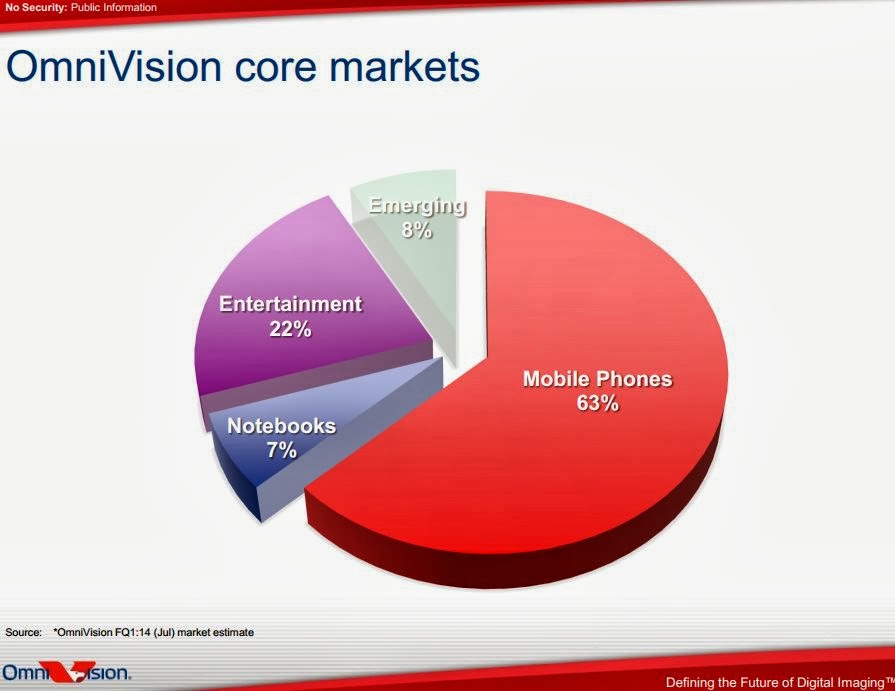
Omnivision has published its Sept. 26, 2013 shareholder presentation with the last year's results and plans for future:

Go to the original article...

Fujifilm Announces CMOS Sensor for Endoscopy

Image Sensors World        Go to the original article...

In consumer applications this Fujufilm's announcement would sound like from 10 years ago. But medical market is different: "Fujifilm is proud to make use of the over-megapixel customised CMOS sensor. Our experience over many years in optoelectronics and electronic imaging shows the superior quality of this technology and we can expect that our customers will see the difference instantly" says Kazuhiko Takemura, Head of European Endoscope Department, Fujifilm Europe.

By adapting a CMOS image sensor, Fujifilm's 600 series endoscopes enable super-high resolution images to be produced. The leading-edge CMOS technology realizes less noise and brilliant images by converting the analog signal to digital in the tip of the scope. During transmission the digital signal is much less affected by any noise from the outside. CMOS technology also realizes 60fps progressive video.

Go to the original article...

Canon PowerShot G16 review – one of the first in-depth reviews of Canon’s compact for enthusiasts!

Camera Labs and DSLR Tips latest news and reviews        Go to the original article...

The PowerShot G16 is the latest version of Canon's chunky compact for enthusiasts. Externally it looks like its predecessor, the G15, and also shares the same 12 Megapixel sensor and 28-140mm equivalent f1.8-2.8 zoom, but the new DIGIC 6 processor lets it focus quicker and shoot much faster at just shy of 10fps, not to mention supporting 1080 / 60p video. There's also a bunch of HDR modes, a Star preset for easy astro-photography, focus peaking and built-in Wifi. It all adds up to a significant upgrade, but how does it compare to industry leaders like the Sony RX100 II? Find out in our in-depth Canon PowerShot G16 review, which is also one of the first published anywhere!

Go to the original article...

Boyd Fowler Joins Google

Image Sensors World        Go to the original article...

Boyd Fowler's LinkedIn page shows that he's now Technical Program Manager at Google, since Sept. 2013. The page indicates that Boyd also continues his previous job at BAE Systems as Technical Director. Boyd has joined BAE through the acquisition of Fairchild Imaging where he was CTO. Boyd Fowler is one of the directors of IISS and recently was Co-Chair of IISW 2013 and the previous workshops too.

Go to the original article...

Pixpolar’s Whitepaper

Image Sensors World        Go to the original article...

Pixpolar publishes a new technology page and a whitepaper discussing advantages of its MIG sensors's Non-Destructive Correlated Double Sampling NDCDS mode. One of the new capabilities of NDCDS is a possibility to choose ISO after the actual shot is taken in DSLRs:

"A great benefit of the MIG sensors is that the signal can be read-out accurately multiple times (due to Non-Destructive Correlated Double Sampling, NDCDS, ability). This means that one can provide the same image with multiple different ISO values. Thus one can either choose afterwards the best ISO setting or one can use different ISO values in different parts of the image. In the latter case the ISO value in each pixel is chosen e.g. such that the ISO is increased until the exposure value of the pixel exceeds a certain limit. This has also the unforeseen advantage that the amount of bits required in the Analog to Digital Converter (ADC) can be reduced while at the same time the Dynamic Range (DR) of the image can be improved.

If rolling shutter is utilized, which is typically the case in digital cameras, the reading of the signal multiple times with different ISO values bears the disadvantage that more skew is resulted in. However, in Digital Single Lens Reflex (DSLR) cameras mechanical shutter is typically used which means that the images are free of skew. Thus the MIG sensors offer for the DLSRs (and generally for digital cameras equipped with a mechanical shutter) a unique ability to afterwards adjust the ISO settings.
"

Another document on MIG sensors advantages for security applications shows the multiple NDCDS simulation results:

MIG Pixel

Go to the original article...

NIST Presents Passive THz Imager

Image Sensors World        Go to the original article...

Eureka: National Institute of Standards and Technology (NIST) have built a prototype passive THz imaging system for detecting hidden weapons and other threats at distances up to 28m away. The technology is similar to the NIST camera in the SCUBA-2 telescope in Hawaii. Both instruments detect emissions at a wavelength of 850um, a wavelength of light that passes through both clothing and the atmosphere. Both sets of sensor arrays are packaged with superconducting amplifiers to boost signal strength, using a NIST technique that makes large arrays practical. But the new imager's sensors are made of a different metal, aluminum, which superconducts at higher temperatures of 1.2 Kelvin. This allows the sensor array to be cooled by a more compact, custom refrigerator.

The NIST imager's video frame rate is currently 6fps, but NIST researchers say their system can be developed further to have four times as many sensors (for a total of 1,004), which would produce larger, near-full-body images at faster video frame rates. A short lab video demonstrating the imager will be available at NIST web site, when it opens again. Here is the older NIST presentation.

Meanwhile, the passive THz imaging seems to attract more and more attention. Other recent works include ones at Johnson C. Smith University at Charlotte, NC, and European THz imaging project commercialized by Spain-based Alfa Imaging:

Go to the original article...

Panasonic Wins Emmy Award for In-Camera Chromatic Aberration Compensation

Image Sensors World        Go to the original article...

Business Wire: Panasonic will be presented with a Technology and Engineering Emmy Award for 2013 by the National Academy of Television Arts & Sciences in recognition of the company’s development of In-Camera Electronic Compensation for Lateral Chromatic Aberrations in External Lenses. The trend to smaller imager formats and less-expensive optics had meant compromises in image performance without an alternative solution to this problem. The concept of modeling the aberrations of a lens and applying real-time electronic correction provides a very significant increase in image quality and permits lower cost-cameras and optics to create better images.

"Panasonic is honored to receive the coveted technical Emmy for its pioneering efforts in the development of Chromatic Aberration Compensation," said Michael Bergeron, Business Development Manager, Panasonic System Communications Company of North America (PSCNA). "This technology has helped us maintain high-quality imaging while making improvements in size, weight and affordability, and now combined with master-quality AVC-ULTRA recording and native 1920 x 1080 imagers, CAC has contributed to new benchmarks for HD acquisition, getting around inherent limitations of optics."

Go to the original article...

css.php