Archives for November 2020

SWIR Sensor for Driver Monitoring

Image Sensors World        Go to the original article...

 Trieye publishes an article "SWIR Keeping a Closer Eye on Driver Monitoring Systems."

"DMS do not function properly under a wide range of scenarios, such as when the sun is shining into a car and the ambient light blinds the camera or when a street is covered with trees or buildings and creates shadow patterns that confuse the DMS algorithms. Another example is when reflections on glasses from different objects and vehicle headlights make it difficult for the gaze detection algorithms to differentiate between pupils and other reflections.

SWIR can be leveraged to solve the low visibility challenge for the car interior with full robustness to ambient illumination. It delivers enhanced vision even under the most challenging scenarios, with significant efficacy at night, when most needed. This function is enabled by operation in the solar-blind region, which prevents glare and shade patterns, combined with the eye-safe powerful illumination (SWIR can be used with 3-5 orders of magnitude more power and still be eye-safe, even in pulsed mode). This allows for an increased Signal-to-Noise Ratio (SNR) and therefore more precise and reliable real-time monitoring."

Go to the original article...

Omnivision Adds Cable to its Endoscopic Offerings

Image Sensors World        Go to the original article...

OmniVision announces the OVMed Cable line of medical endoscope, catheter and dental cables, to create a platform in combination with the company’s portfolio of CameraCubeChip wafer-level camera modules and OVMed ISP boards. Looking on Omnivision endoscopic products, it started from a sensor, then wafer level optics has been added, then ISP, and now, there is a long cable connecting them all together.


BusinessWire: OmniVision and Almalence announce a joint solution that eliminates the conflict between camera size and resolution found in current medical imaging solutions. The solution is based on OmniVision’s OVM6948 CameraCubeChip—the world’s smallest fully packaged, wafer-level camera module measuring 0.65mm x 0.65mm, with a z-height of just 1.158mm. Almalence pre-tuned its SuperResolution algorithm, effectively increasing the OVM6948’s resolution by 1.5x to 300x300 and boosting its SNR by up to 8dB for a total of about 42dB. These increases would otherwise double the image sensor and camera size, due to the required increase in pixel count.

Go to the original article...

Nikkei: Samsung Challenges Sony

Image Sensors World        Go to the original article...

Nikkei Asian Review talks about Samsung and Sony fight for the leadership on the image sensor market:

"Sony, which commands more than half of the market, has prioritized the supply of image sensors to Huawei and other leading smartphone manufacturers. But the strategy has backfired.

"Sony maintains a cautious stance, while Samsung is going on an investment offensive as if now is their chance," said an official with a supplier of equipment used in the production process of image sensors. "The two companies are demonstrating totally different moves."

The comment followed several large orders the supplier won in August and September, all of which were from South Korea's Samsung.

As a late comer to the image sensor market, Samsung has been doing business with Apple and Huawei on a limited scale while attracting smaller customers such as China's Xiaomi and Vivo, which are boosting smartphone production in expectation of demand for alternatives to Huawei versions.

Samsung, therefore, is highly likely to benefit from the rise of smaller Chinese smartphone makers.

Sony, for its part, has a strategy for meeting Samsung's challenge. "We will strive to expand and diversify our customer base looking ahead to fiscal 2021, " Hiroki Totoki, the company's executive deputy president, said at a press conference in October. "Recovery of profitability is expected in earnest in fiscal 2022.", he added.

But one analyst familiar with the matter said it will be difficult for Sony to "fully make up for a drop in supplies to Huawei with an increase in sales to other companies this business year."

"Sony's sensor may not answer the demand needs of (smartphone) makers pursing a high number of pixels," said Tetsuo Omori, senior analyst at Japanese research company Techno Systems Research."

Go to the original article...

Nikon Z TC-1.4x TC-2.0x teleconverter review

Cameralabs        Go to the original article...

The Nikon Z TC 1.4x and TC 2.0x are the first tele-converters for the Z-series mirrorless system. Introduced with the Z 70-200mm f2.8 pro zoom, they extend the reach of compatible lenses without the cost or bulk of buying a new model. Find out how they both perform on the Z 70-200mm in our in-depth review!…

The post Nikon Z TC-1.4x TC-2.0x teleconverter review appeared first on Cameralabs.

Go to the original article...

Nikon Z TC-1.4x TC-2.0x teleconverter review

Cameralabs        Go to the original article...

The Nikon Z TC 1.4x and TC 2.0x are the first tele-converters for the Z-series mirrorless system. Introduced with the Z 70-200mm f2.8 pro zoom, they extend the reach of compatible lenses without the cost or bulk of buying a new model. Find out how they both perform on the Z 70-200mm in our in-depth review!…

The post Nikon Z TC-1.4x TC-2.0x teleconverter review appeared first on Cameralabs.

Go to the original article...

LiDAR News: Velodyne, Apple, DJI

Image Sensors World        Go to the original article...

BusinessWire: Velodyne presents a solid-state Veloarray H800:

"The solid state Velarray H800 is architected for automotive grade performance and built using Velodyne’s breakthrough proprietary micro-lidar array architecture (MLA).

...will be available at high-volume production levels with a target price of less than $500 to drive broad adoption in consumer and commercial vehicle markets.

With a field of view of 120 horizontal degrees by 16 vertical degrees, the Velarray H800... provides perception data at a range of up to 200 meters."


Forbes contributor Sabbir Rangwala analyses iPhone 12 LiDAR impact on the market:

"The LiDAR in Apple’s new iPhone moves 3D imaging from the esoteric to the ordinary. It is a significant boost for the technology, similar to photography's transition in the mid-2000s from a specialized world of cameras and lenses to a simple finger-click that can be relished and shared via a general-purpose smartphone by billions of consumers.

Some automotive LiDAR companies are pursuing similar architectures as the iPhone 12 (8XX/9XX nm VCSELs and SPADs). This includes Sense Photonics, Ouster, Opsys Tech, and ZF/Ibeo. Lumentum reportedly supplies VCSELs for the iPhone 12 LiDAR and is also making a focused effort to penetrate the automotive LiDAR market."


CNET quotes iPhone 12 depth accuracy data, as measured by Occipital's VPs of Product Alex Schiff and Anton Yakubenko using their Canvas 3D scanning application:

"The iPhone 12 version of Canvas takes more detailed scans than the first version on the iPad Pro earlier this year, mostly because of iOS 14's deeper access to lidar information, according to Occipital. The newest lidar-enabled version is accurate within a 1% range.

Yakubenko says by Occipital's previous measurements, Apple's iPad Pro lidar offers 574 depth points per frame on a scan, but depth maps can jump up to 256x192 points in iOS 14 for developers. This builds out more detail through AI and camera data."

Fstoppers: DJI adds a LiDAR AF sensor to its RS2 gimbal so that any manual focus lens can be turned into AF one:

Go to the original article...

Tower to Start Stacked BSI Production Next Year

Image Sensors World        Go to the original article...

SeekingAlpha: Tower Q3 2020 earnings call updates on its image sensor business:

"We have achieved very good results and expect manufacturing to start shortly for lens-type fingerprint sensors. On time-of-flight sensor front, we also received very good results from our lead customer sensors and are moving according to the plan to production in the first half of next year. This would be our first product moving to mass production, using our 300-millimeter stacked wafer backside illumination pixel-level bonding platform.

We continue to see weakness in 2 market segments, the X-ray dental sensor market and the industrial sensor market, however, we begin to see a rebound in customer bond forecast for industrial sensors."

Go to the original article...

Himax Reports Quarterly Results

Image Sensors World        Go to the original article...

GlobeNewsWire: Himax reports its Q3 results and updates on its image sensor business:

"In smart phone application, Himax targets next generation Android smartphones and the Company is collaborating with leading laser and ToF sensor vendors to develop a new world-facing 3D sensing camera whereby it provides optical components and/or projectors which are critical for the performance of the whole ToF solution.

For non-smartphone 3D-sensing engagements where the Company provides a structured light-based 3D sensing total solution, its target markets range from smart door lock, facial recognition-based e-payment, business access control to biomedical inspection device. A number of recent design-wins will enter into mass production soon.

Alternatively, Himax also offers a market leading 3D decoder ASIC to those customers who wish to design their own structured light 3D sensing solution. Here the Company has had quite a few design-wins from customers targeting China’s vast e-payment market with some shipments already starting in the fourth quarter. The Company is also working with customers for industrial robotics, smart door lock and home security, all of which carry great potential for Himax’s 3D business in the future.

Ultralow power smart sensing

To further lower the technical barrier for using Himax’s WiseEye solution, the Company teamed up with a leading online store specialized in easy development tools for machine learning on edge devices. Himax is extremely excited about the rapid business progress and believes the Company’s WiseEye offerings will become a major contributor to its P&L in the near future.

CMOS Image Sensor

The Company continues to see extremely strong demands for its CMOS image sensors for IP camera and notebook, but its actual shipment has been badly capped by the foundry capacity available to it. Separately, Himax’s industry-first 2-in-1 CMOS image sensor that supports RGB mode for video conferencing and ultralow power AI mode for facial recognition has penetrated the laptop ecosystem for their most stylish super slim bezel designs. The Company expects to have small volume shipment toward late 2020 with more to come in next year.

Regarding ultralow power always-on CMOS image sensor, which targets in battery powered or always-on applications, Himax is getting promising feedback and design adoptions from customers in various markets, such as car recorders, surveillance, smart electric meters, drones, home appliances, and consumer electronics. In Q4, CIS revenue is expected to be flat sequentially although demand is much stronger than that. Again, its shipment is capped by foundry capacity constraint."

Go to the original article...

BeyonSense Demos its SWIR Camera

Image Sensors World        Go to the original article...

 BeyonSense-Stratio-LinkSquare demos its SWIR Ge-based sensor capabilities:


Go to the original article...

Yole: Chinese Companies are the New Leaders on the Thermal Imager Market

Image Sensors World        Go to the original article...

 Yole Developpement report "Thermal Imagers and Detectors 2020" updates:

"The current surge of EST [elevated body or surface temperature] applications has transformed the thermal imager manufacturer landscape, at least for thermography. In 2019, US and EU players (FLIR, Lynred, SEEK) were leading this market. Enter COVID-19, and Chinese players (Guide IR, Hikvision, Iray) have turned the tables, surpassing the market leaders, at least in shipments. They rapidly addressed the great domestic demand for thermal imaging systems. Having acquired in the past few years technical competences in thermal imager manufacturing, these Chinese players ramped up their domestic production during the last 2 years, and the current situation has fueled their path to becoming stars. As the epidemic spread across geographies to the west, the rest of the companies reaped the benefits from this hype. But western countries were slower in adopting thermal cameras en masse, due to privacy concerns.

In general, thermal imager production lines are not like other integrated circuit (IC) production lines that work at more than 90% of production capacity. Therefore, for some companies there was not a particular need for investment, besides some increase in consumables and possibly workforce. But for some Chinese companies, it is highly possible that the government has supported their production ramp ups. Moreover, this situation could push Chinese companies to chase investments for future growth, which could rapidly develop the market in the future.

But what could happen next year? Chinese manufacturers have enormous production capacity which risks being left unused. We could be spectators to huge changes in strategy where they could:

  • Revert back to applications such as traditional thermography and surveillance. For  example, companies with existing strong sales channels in traditional non-thermal surveillance can push forward thermal imaging technology. This could potentially lead to big price wars.
  • Find new growth drivers, for example from big markets that are still left untapped. These include consumer applications such as smartphones and smart homes, industrial applications including smart buildings. They could enter the Internet of Things (IoT) world by leveraging megatrends such as 5G and artificial intelligence (AI) in an ultra-connected, intelligent world.

At this point, many uncertainties exist. One thing is sure: exciting times lie ahead for the thermal imaging industry."

Go to the original article...

Limits of HDR Imaging with Quanta Image Sensors

Image Sensors World        Go to the original article...

Arxiv.org paper "HDR Imaging with Quanta Image Sensors: Theoretical Limits and Optimal Reconstruction" by Abhiram Gnanasambandam and Stanley H. Chan from Purdue University shows DR advantage of QIS over CIS:

"High dynamic range (HDR) imaging is one of the biggest achievements in modern photography. Traditional solutions to HDR imaging are designed for and applied to CMOS image sensors (CIS). However, the mainstream one-micron CIS cameras today generally have a high read noise and low frame-rate. These, in turn, limit the acquisition speed and quality, making the cameras slow in the HDR mode. In this paper, we propose a new computational photography technique for HDR imaging. Recognizing the limitations of CIS, we use the Quanta Image Sensor (QIS) to trade the spatial-temporal resolution with bit-depth. QIS is a single-photon image sensor that has comparable pixel pitch to CIS but substantially lower dark current and read noise. We provide a complete theoretical characterization of the sensor in the context of HDR imaging, by proving the fundamental limits in the dynamic range that QIS can offer and the trade-offs with noise and speed. In addition, we derive an optimal reconstruction algorithm for single-bit and multi-bit QIS. Our algorithm is theoretically optimal for all linear reconstruction schemes based on exposure bracketing. Experimental results confirm the validity of the theory and algorithm, based on synthetic and real QIS data."


Go to the original article...

Brookman Compares Continuous and Pulsed iToF

Image Sensors World        Go to the original article...

Brookman compares continuous and pulsed iToF approaches with respect to the tolerance to ambient light:

Go to the original article...

Smartsens CEO Named Innovator of the Year

Image Sensors World        Go to the original article...

BusinessWire: SmartSens Founder and CEO Richard Xu received a 2020 Innovator of the Year Award at ASPENCORE Global High-Tech Executive Forum.

In an interview with ASPENCORE China analyst, Xu comments on the future of SmartSens:

As a CMOS image sensor chip design company driven by innovation, SmartSens has selected the technically demanding security product industry as a market entry point. We’ve able to take advantage of the country’s rapid advancements and explosive growth in smart cities and intelligent transportation to become a leader in this field.

In particular, our ultra-starlight-level full-color night vision imaging technology, Stack BSI Global Shutter technology, single-frame HDR technology, and Near-Infrared Enhancement technology among others that have garnered recognitions by leading customers in the security industry.

Regarding the future of semiconductor industry in China, Xu says:

Currently, the country can only provide 15% of the overall chip supply, while the demand is over 50%. In addition, there is a demand for high-end chip customization. This presents an opportunity for the domestic semiconductor industry to tap into this rapid development.

From a more passive point of view, it means that domestic companies must examine their own potential. Technological innovation is the key. With a global strategy and strong national sentiment, as well as respect of intellectual property and common-ground value, the market will prove that a win-win situation is attainable.

Go to the original article...

Assorted News: ON Semi, Luminar, Galaxycore, Omnivision

Image Sensors World        Go to the original article...

BusinessWire: ON Semiconductor introduces a single point dToF LiDAR solution based on the company's Silicon Photomultiplier (SiPM). The SiPM dToF LiDAR Platform can detect objects at distances between 10 cm and 23 m.

The SiPM dToF LiDAR Platform provides a complete solution for low cost, single point LiDAR that OEMs can adapt and take into production to create industrial range finding applications. It includes the NIR laser diode, SiPM sensor and optics, as well as the digital processing necessary to convert the detected signals into elapsed time, and elapsed time into distance.

BusinessWire: Luminar makes a number of public announcements toward closing its reverse merging IPO deal:

  • Luminar is engaged with 50% more OEM programs for series production deals to be awarded over next 24 months (now 12, up from 8 in August; only 4 modeled in financial forecast)
  • Luminar executed exclusive supply agreements for all three of its key lidar components (receiver, ASIC, and laser), locking in an estimated sub $100 hardware cost in volume.
  • Luminar is on-track for powering series production vehicles in 2022: delivered key milestone of Iris B-samples; shipped to its lead series production partner Volvo Cars and live on vehicles.
  • Luminar is increasing its target 2020 Order Book from $1 billion to approximately $1.3 billion, due to new OEM deals and increased existing customer volume outlook provided
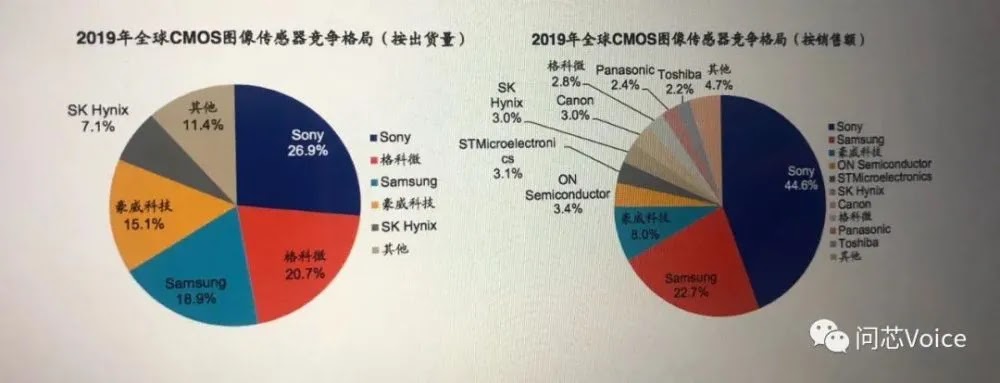
Deeptech posts the notes from Galaxycore investor presentation towards its IPO. Here are Galaxycore's view on image sensor market shares in units and value:

"According to Frost & Sullivan statistics, in 2019 the global mobile phone CMOS image sensor shipments of 4.93 billion, market size reached $ 12.08 billion, is expected to 2024, global hand machine CMOS sensor size will reach 6.78 billion, the market scale reached 16.41 billion yuan .

In terms of 2019 unit shipments, the world's top four CMOS image sensor chips are SONY with 26.9%, Galaxycore 20.7%, Samsung 18.9%, and Omnivision 15.1%.

In terms of sales amount, the top ten in 2019 are SONY with 44.6%, Samsung 22.7%, Omnivision 8%, ON SEMI 3.4%, STMicroelectronics 3.1%, SK Hynyx 3%, Canon 3%, Galaxycore 2.8%, Panasonic 2.4%, Toshiba 2.2%, etc.
"


Netease adds: "according to the statistics of unit shipments in 2019, Galaxycore’s global market share has reached 20.7%. In the segment of mobile phone applications, Galaxycore accounted for 24.3% of the global market share with 1.2 billion unit shipments."

BusinessWire: Omnivision, Ambarella, and Smart Eye announce what they call the automotive industry’s first complete solution for dual-mode camera applications. This joint solution simultaneously monitors drivers while capturing vehicle occupants for one-way videoconferencing.

Our OV2312 is the only automotive image sensor that offers the combination of dual-mode RGB-IR capture and a global shutter,” said Mario Heid, VP of OmniVision Europe. “Without this combined functionality, the camera system designers would have to use two separate image sensors, which is too expensive for most vehicles. At the same time, the European Union (through Euro NCAP) is requiring that all new cars sold in Europe have a driver monitoring system (DMS) camera by 2022, and our joint solution gives OEMs the flexibility to differentiate their vehicle features while meeting this mandate.

Go to the original article...

Yole on CIS Trends

Image Sensors World        Go to the original article...

 Yole Developpement report "The CIS industry overheated in 2019 reaching $19.3B. Are we heading to a soft landing in 2020-2021?" says:

"At the top of the market, player trajectories are a consequence of the smartphone market situation. Sony and Samsung are first and second and Omnivision third. ST Microelectronics is in fourth position, making a comeback thanks to its near infrared (NIR) sensing imagers for Apple handsets and tablets. Sony and Samsung have subsequently updated their product portfolio in line with the 3D sensing trend. Indirect Timeof-Flight (iToF) and direct Time-of-Flight (dToF) arrays are the immediate response, showing the great technical innovation driving those top players.

On the other side of the market, emerging players to watch are coming from China. Omnivision has been acquired by Will Semiconductor, the Shanghai-based company. Two other Chinese players, Galaxycore 

and Smartsens, are also experiencing thriving growth. They have mostly benefited from their domestic market ecosystem in mobile and security cameras. Their growth is currently fueled by massive capital injections at time of greater US sanctions limiting their access to technology. CIS might be among the first semiconductor product categories in which China could become technologically independent since the required wafer foundries are widely available in mainland China.

The next era will involve robotics, Augmented Reality (AR) and smart Internet of Things (IoT). All of these are markets in which Chinese companies are well positioned. The ranking of CIS players will eventually change along these new lines."

Go to the original article...

Camera and Sensor Tutorial

Image Sensors World        Go to the original article...

EDN publishes camera tutorial by Richard Crisp, Etron VP of New Product Development. Its third part about rolling and global shutter has a nice visualization of the dark current statistics:

Go to the original article...

Infineon Estimates ToF Sensor Market

Image Sensors World        Go to the original article...

 Infineon's quarterly Investor Presentation shows the company's forecast of ToF sensor market:

Go to the original article...

GigaDevice Develops SWIR ToF Sensor for Smartphones

Image Sensors World        Go to the original article...

Sohu (via IFNews), Zaotech: Gigadevice Director of ToF Marketing of the Sensor Division Haolei Liu presents the company plans to develop ToF sensors and optical fingerprint sensors for smartphones:

"GigaDevice’s innovative ToF solution adopts a special process, has a higher QE, can effectively reduce power consumption and system cost, and can support both the 1350nm-1550nm long wavelength band and the 940nm wavelength band. Outdoors have excellent performance, which meets the needs of the future screen direction.

Liu Haolei also pointed out: “In our opinion, iToF and dToF will be parallel for a period of time. Although the resolution is a shortcoming of dToF, in the long run, we believe that dToF has a lot of room for growth because of the dToF solution. Not long after its launch, the industrial chain is not mature, which also means that it has a lot of room for improvement.

We believe that the potential of ToF needs to be promoted by industry chain ecological partners. It is certain that this technology will have higher and higher requirements for hardware . For example, resolution. In the dToF solution, if the resolution can be significantly improved, the application of products will become more and more extensive.

The new GigaDevice's ToF sensor is said to have QVGA resolution, QE of 65% at 940nm or 50% at 1350nm, "which is nearly double that of the ToF chip based on silicon technology."

MEMSensor: The company also develops a new α-Si process-based under OLED-screen optical fingerprint sensor named GSL7253. It's said to have a sensitive area of 20x30mm2, a QE of 80%, and is only 0.3mm thin:

Go to the original article...

Image Sensor Wafers for $25

Image Sensors World        Go to the original article...

A number of Ebay sellers offer "research" 8-inch image sensor wafers for $25 a piece. Possibly, they could serve as a nice souvenir:

Go to the original article...

Galaxycore IPO Approved at $7.5B Valuation

Image Sensors World        Go to the original article...

FinanceSecond, NetEase: GalaxyCore listing at Science and Technology Innovation Board of the Shanghai Stock Exchange has been approved by authorities. The IPO includes 15% share of the company at the price of 7,428,830,300 RMB (about $1.124B). This values the company at $7.5B.

The money will be invested into CIS R&D and 12-inch wafer BSI processing facility that Galaxycore built in Lingang New Area of China (Shanghai) Free Trade Pilot Zone.

"Through the construction of some 12-inch BSI wafer back-end production lines, 12-inch wafer manufacturing pilot lines, some OCF manufacturing and back grinding and cutting production lines, the company has realized the transition from the Fabless model to the Fab-Lite model."

Go to the original article...

Velodyne Reports Q3 2020 Results

Image Sensors World        Go to the original article...

BusinessWire: As a public company, Velodyne reports its quarterly results, giving a good food for thought about LiDAR market as a whole:

  • Revenue: Total revenue of $32.1M represents a 137% increase year-over-year.
  • Units and ASPs: We shipped 2,235 sensor units with a ASP of approximately $5,600.
  • Gross Profit: GAAP and non-GAAP gross profit totaled $15.0M. Previous public guidance reflected a third quarter benefit from a one-time $11M stocking fee, which positively impacted gross profit.
  • Net Loss: GAAP net loss was $5.3M and non-GAAP net loss was $9.1M.
  • Liquidity: Cash of $298M was on the balance sheet at the end of the third quarter.
  • For the full year 2020, we expect total revenue of approximately $101M, as previously forecasted.
  • For the full year, GAAP operating loss is expected to total between $208M and $205M.

Go to the original article...

Assorted News: Ambarella, ON Semi, Omnivision

Image Sensors World        Go to the original article...

BusinessWire: Ambarella introduces the CV28M camera SoC, the latest in the CVflow family, combining image processing, high-resolution video encoding, and CVflow computer vision processing in a single, low-power design. The CV28M’s efficient AI architecture provides the flexibility to enable a new class of smart edge devices for applications including smart home security, retail monitoring, consumer robotics, and occupancy monitoring.

All around us, devices are becoming smarter, and with our newest CV28M SoC, our customers can develop a new generation of intelligent sensing cameras for a variety of new applications,” said Chris Day, VP of marketing and business development at Ambarella. “In privacy-sensitive applications—such as monitoring retail stores, workplaces, rental properties, or the elderly at home—edge-based AI processing can support intelligent monitoring and fast decision-making without the requirement to record or stream video to the cloud.


ON Semi publishes a promotional video about its SiPM use in dToF laser rangefinders:


ResearchInChina reviews the ADAS market design wins for major vision processor companies:


AspenCoreGroup, the mother company of EETimes, EDN, and many other electronics magazines, announces its  Global Electronic Achievement Awards 2020. In the sensors category, the Award goes to Omnivision OV64B sensor.


Digitimes reports that OmniVision is ramping up the volume production of OV64A in Q4 2020 for Xiaomi, Oppo and Vivo in their midrange and high-end smartphones.

As China continues its de-Americanization and self-sufficiency policy in semiconductors, OmniVision is expected to significantly increase its share on Chinese CIS market, according to Digitimes sources.

Go to the original article...

Soitec Presents IR Sensitivity Improvements in FSI Sensors

Image Sensors World        Go to the original article...

Soitec says that its "Imager-SOI [wafer] product line is designed specifically for fabricating front-side imagers for near-infrared (NIR) applications including advanced 3D image sensors."

The product line is available in 300mm. BOX from 15nm to 150nm. “Epi Ready” Top silicon from 50nm to 200nm.

Go to the original article...

Soitec Presents IR Sensitivity Improvements in FSI Sensors

Image Sensors World        Go to the original article...

Soitec says that its "Imager-SOI [wafer] product line is designed specifically for fabricating front-side imagers for near-infrared (NIR) applications including advanced 3D image sensors."

The product line is available in 300mm. BOX from 15nm to 150nm. “Epi Ready” Top silicon from 50nm to 200nm.

Go to the original article...

Sub-Micron X-Ray Pixels

Image Sensors World        Go to the original article...

Waterloo Institute for Nanotechnology is going to design sub-micron pixels for X-Ray ptychography. In regular X-ray sensors, the pixel pitch is 100-200um or more.

Go to the original article...

CIS Market to Grow 1% in 2020, 12% in 2021

Image Sensors World        Go to the original article...

IC-Insights forecasts a slight growth of image sensor market this year, followed by a 12% growth in 2021:

Go to the original article...

Samsung Launches 4-Tap iTOF Sensor

Image Sensors World        Go to the original article...

 Samsung unveils its first iTOF product - ISOCELL Vizion 33D:

"Featuring 4-tap pixels, the Samsung ISOCELL Vizion 33D delivers precise and swift depth sensing capabilities for next-level 3D applications.

Enabling pro-grade shots with bokeh effects or accurate 3D object images, the ToF (Time-of-Flight) sensor is optimized to provide best-in-class photography and AR/VR experiences.

To enable precise depth measurement of fast-moving objects, the ISOCELL Vizion 33D features a 4-tap demodulation system and supports frame rate of up to 120fps. Each pixel in the sensor can receive four phase signals simultaneously (0°, 90°, 180°, and 270°), which means it can generate a depth image with just a single frame. The ISOCELL Vizion 33D can capture moving objects with significant reduction of motion artifacts.

In both indoor and outdoor conditions, the sensor can detect the depth of an object within up to 5m with high accuracy. ISOCELL’s pixel technology, coupled with high resolution, enables the sensor to accurately separate objects from the background with 3D bokeh effect.

Deep Trench Isolation technology (DTI) maximizes isolation between pixels to reduce crosstalk, while Backside Scattering Technology (BST) enhances the sensor’s quantum efficiency. With high-precision depth images, the ISOCELL Vizion 33D delivers next-level 3D applications, such as facial authentication for payment services.

With a total power consumption of under 400mW for both IR illuminator and the ToF sensor, the 33D makes it possible for users to enjoy powerful 3D features, such as AR games and video bokeh, throughout the day."

Go to the original article...

DJI Mini 2 Review

Cameralabs        Go to the original article...

The DJI Mini 2 is a brand new replacement for the 249g Mavic Mini. It drops the "Mavic" but retains essentially the same folding airframe. Why, you might wonder, is a drone getting a significant refresh less than 13 months after launch? Find out in my full review!…

Go to the original article...

Zeiss Use of MALS is "The Biggest Breakthrough in Microscopy Since the Invention of Microscope"

Image Sensors World        Go to the original article...

Zeiss Visioner 1 digital microscope uses SD Optics' Micro-mirror Array Lens System (MALS) technology to achieve digitally-extended depth of focus up to 69mm:

"ZEISS Visioner 1 revolutionizes the world of optical inspection and documentation. Driven by the unique Micro-mirror Array Lens System (MALSTM technology), enables for the first time, real-time all-in-focus imaging – first time, every time.

Using a micro-mirror array lens system (MALS™) enables us to generate “virtual” lenses with distinctly different curvatures, thus different focus planes. This is achieved by changing the orientation of each individual micro-mirror in an orchestrated way.

Re-shaping the curvature of this “virtual” lens at speed enables ultra-fast focusing and real-time all-in focus imaging and documentation.
"

  • Up to 100x more usable Extended Depth of Field
  • Allows for height differences of up to 69mm*
  • Reflective micro-mirror array with curvatures (variable) arranged in a flat plane
  • Each micro-mirror is about 100x100 µm
  • Each micro-mirror rotates & translates to form the optical surfaces with variable curvatures
  • No need for Z-stacking or re-focusing


Go to the original article...

Canon RF 50mm f1.8 STM review

Cameralabs        Go to the original article...

The Canon RF 50mm f1.8 STM is a low-priced standard prime lens for the EOS R mirrorless system. It becomes the cheapest model in the RF catalogue to date while also featuring a number of improvements. Check out my review to see how it compares to the older EF version!…

Go to the original article...

css.php