Recent Videos: HK University, Almalence, Sony AI, Cube Eye, Imatest, Trieye

Image Sensors World        Go to the original article...

Hong Kong University publishes its video poster on modeling of Current-Assisted Photonic Demodulator (CAPD) for iToF sensors:


Almalence demos its super resolution approach with Omnivision endoscopic sensor OVM6948:


Sony AI publishes a video "Imaging & Sensing Project:"


Meere company presents Cube Eye ToF camera capable to operate in 100Klux sunlight:


Imatest publishes a webinar on automotive camera characterization according to P2020 standard:


Go to the original article...

Recent Videos: HK University, Almalence, Sony AI, Cube Eye, Imatest, Trieye

Image Sensors World        Go to the original article...

Hong Kong University publishes its video poster on modeling of Current-Assisted Photonic Demodulator (CAPD) for iToF sensors:


Almalence demos its super resolution approach with Omnivision endoscopic sensor OVM6948:


Sony AI publishes a video "Imaging & Sensing Project:"


Meere company presents Cube Eye ToF camera capable to operate in 100Klux sunlight:


Imatest publishes a webinar on automotive camera characterization according to P2020 standard:


Go to the original article...

8-inch CIS TSV Fab in China Gets 100M RMB Investment

Image Sensors World        Go to the original article...

Sohu: Suzhou Keyang Semiconductor Co., Ltd. (Keyang Semiconductor) receives a strategic investment of more than 100M yuan. After the completion of this round of investment, Keyang Semiconductor will accelerate the upgrade of the CIS production line.

Li Yongzhi, Director and CEO of Keyun Semiconductor, says: "In the face of new opportunities, Keyang Semiconductor will continue to dig deeper in the field of advanced semiconductor packaging, and is committed to becoming the world's leading through-silicon via (TSV) and wafer-level packaging (WLP) solution provider!"

Go to the original article...

Ambarella Presents Artificial Intelligence Image Signal Processor (AISP)

Image Sensors World        Go to the original article...

GlobeNewswire: Ambarella announces an Artificial Intelligence Image Signal Processor (AISP). The new AISP will become available across Ambarella’s entire CVflow SoC portfolio at resolutions up to 4K. The applications of this technology encompass all of the company’s target markets, where low-light and HDR processing are critical. This includes security and automotive cameras, where full-color night vision is a key operating point, and where better low-light and HDR enable reductions in external illumination, the use of lower cost sensors, and cleaner video for both human viewing and analytics processing.

A good example of this new technology in action is a typical security camera trying to identify a license plate at night. With noisy video, the text on the license plate would be unreadable, even to the best AI algorithm. And with black and white video, all color information on the car would be lost. By using Ambarella’s AISP technology and restoring colors at the source before AI processing, the license plate can be clearly read and the color of the car identified.

Go to the original article...

Q&A with Eric Fossum

Image Sensors World        Go to the original article...

Dartmouth publishes "Q&A with engineering professor and Technology and Engineering Emmy winner Eric Fossum." Few quotes:

"The winners of the Emmy awards that were announced were me as the primary inventor, as well as Kodak. I was also very happy that we were able to get some extra trophies for some of my other team members of PhotoBit.

Now we have moved on to a new technology at Dartmouth and my research lab, which is an even more sensitive camera chip called a quanta image sensor.

It counts individual photons of light one at a time. I started it probably about five years ago, when we were doing a lot of research. But then my Ph.D. students and I co-founded a startup company out of Dartmouth called GigaJot, which is now operating in southern California. So now we’re again trying to commercialize that technology, and maybe it’ll make it to your smartphone someday. We’ll see.

Our photon counting sensor clock and image sensor still have their own limitations. I’m trying to understand the semiconductor device physics behind the background noise in these devices because it limits the perfection of the sensitivity. So I want to understand what those limits are all about. It’s really pushing the forefront."

Go to the original article...

Omnivision Presents 5MP Sensor with 2.2um RGB-IR Global Shutter Pixels

Image Sensors World        Go to the original article...

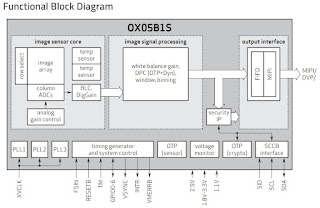
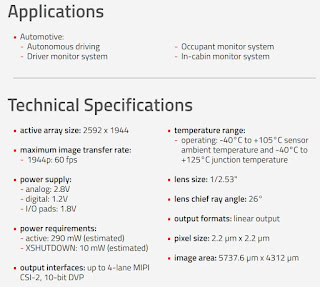
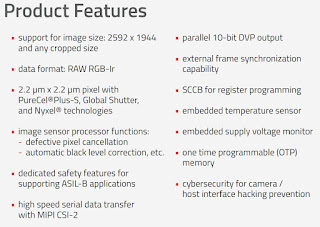
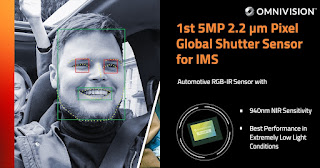
BusinessWire: Omnivision announces the latest addition to its Nyxel NIR family―the OX05B1S is the automotive industry’s first 5MP RGB-IR BSI global shutter sensor for in-cabin monitoring systems (IMS) with a pixel size of just 2.2µm with improves 940nm NIR sensitivity. Additionally, it is the first RGB-IR sensor for in-cabin monitoring to feature integrated cybersecurity.

According to Colin Barnden, principal analyst at Semicast Research, “The DMS sector represents a huge growth opportunity for in-cabin cameras, with almost all automotive OEM nominations still to be decided. Based on OMNIVISION’s revolutionary Nyxel NIR technology, the new OX05B1S brings dramatically improved resolution as well as overall enhanced efficiency and design flexibility to automotive OEMs seeking high performance operation across the full spectrum of lighting conditions.

The automotive industry can now transition from 1 and 2MP to 5MP with our new RGB-IR BSI global shutter sensor, and they only need one camera instead of two for simultaneous driver and occupant monitoring systems, reducing complexity, cost and space,” said Andy Hanvey, director of automotive marketing at OMNIVISION. “We anticipate high demand for the OX05B1S and have already been awarded OEM projects. Most importantly, we developed it with strong ecosystem partner support, working with companies such as Seeing Machines, to enable a complete, seamless solution for automotive OEMs.

The OX05B1S is said to have the industry’s highest NIR QE at 36% (a 3X boost from 12% in the previous generation). The sensor comes in an OMNIVISION stacked a-CSP package that is 50% smaller than competitive products and allows for higher-performance image sensors in tighter camera spaces. It is also available in a reconstructed wafer option for designers who want the flexibility to customize their own package.

The OX05B1S has an “always on” optional feature. Samples of the OX05B1S are available now and the sensors will be available in mass production in Q1 2023.

Go to the original article...

Omnivision Launches 3MP SoC for Automotive Cameras with Low Power and Small Size

Image Sensors World        Go to the original article...

BusinessWire: Omnivision launches the OX03D, a 3MP SoC for automotive surround-view systems (SVS), rearview systems (RVS) and e-mirrors. The new SoC provides a path for automotive OEMs to upgrade from 1MP to 3MP while retaining a 1/4-inch optical format. The OX03D4C has a fully integrated ISP, is capable of 140dB HDR and includes the tone-mapping algorithm along with the LED flicker mitigation (LFM).

It features 105dB motion-free HDR with a total range of 140dB, and provides HDR and LFM simultaneously. The OX03D supports a number of CFA patterns, and can output both YUV and RAW process streams at the same time. The OX03D4C provides four on-screen display overlay layers for driver guidelines, as well as distortion correction to straighten any curved edges from lenses with a wide viewing angle. The OX03D4C consumes less than 500 mW power, enabling the use of a plastic case for lighter weight and lower cost.

Go to the original article...

Omnivision Unveils 200MP Sensor with 0.612um Pixels

Image Sensors World        Go to the original article...

BusinessWireOmnivision announces the OVB0, said to be the world’s smallest 200MP image sensor with pixel size at just 0.61µm for smartphone cameras. The OVB0B is the first 200MP to offer 100% quad phase detection (QPD) for fast autofocus.

The OVB0B features the industry’s first 16-cell binning capability for 4K2K video with 16 times the sensitivity. In low light environments it achieves 12.5MP performance with 2.44µm-equivalent pixel size using near pixel 4x4 binning. An on-chip remosaic enables 50MP at 24 fps and 8k video at 30 fps with 1.22µm-equivalent performance. The OVB0B can also output 12.5MP at 30 fps with 3-exposure staggered HDR timing.

Consumers want high resolution captures and high quality preview and video. As the image sensor technology leader, we have applied our PureCel Plus-S stacked die technology to dramatically push mobile main cameras to a new level,” said Arun Jayaseelan, staff marketing manager at Omnivision. “With the new OVB0B, we now offer the industry’s highest resolution in a small package for high end smart phones along with the best low-light performance in its class.

We estimate more than 40 million image sensors with 100MP+ resolution are expected to be shipped to smartphone vendors in 2022,” says Jeffrey Mathews, senior analyst at Strategy Analytics.

The OVB0B supports CPHY, DPHY and dual DOVDD (1.8V and 1.2V). Samples of the OVB0B are available now.

Go to the original article...

Sony Concept Car Features 18 Cameras and 4 LiDARs

Image Sensors World        Go to the original article...

PRNewswire: Sony announces Vision-S concept vehicle. It has 18 cameras and 4 LiDARs:

Go to the original article...

VPS Semiconductor Raises 100M RMB in A-Round on Promises of 0.5um Pixel and 600MP Resolution

Image Sensors World        Go to the original article...

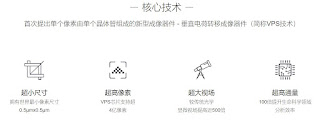
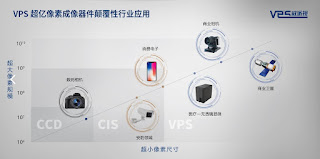
SemiconductorEngineeringVPS Semiconductor startup promising "For the first time, a new type of imaging device with a single pixel composed of a single transistor-vertical charge transfer imaging device (VPS technology for short)" raises 100M yuan in series A financing round.

"Perfect fusion of high resolution and large field of view ultra-small pixel size 0.5 micron - ultra-large pixel size of 400 million pixels.

With independent innovation of vertical charge transfer imaging device (VPS) as the core, the company focuses on the development and application design of next-generation ultra-large-scale pixel image sensor chip products, and is committed to providing future-oriented and high-quality imaging performance for medical, commercial satellites and other fields. Large-scale imaging chips and solutions are the leader of billion-pixel imaging chip solutions.

The founding team of the company comes from Nanjing University, Sony, Infineon and other well-known universities and overseas famous chip companies. The R&D team has an average of more than 10 years of industry experience.

The team has completed the research and development and verification of the first chip with a pixel size of 400 million and a pixel size of 0.5 microns. It is the smallest and largest pixel size imaging chip that has been reported. It is mainly used in medical in vitro diagnostics and other fields to help doctors improve diagnosis efficiency , The product is expected to reach 1 billion yuan/year output value within 5 years after the development is completed, and 40+ core intellectual property rights have been applied for.

At present, VPS Vision’s first 600 million pixel imaging chip has begun to be taped out in domestic fabs. This chip has a 0.5 micron pixel size and is known as a digital microchip that can directly "see" cells. It can be revolutionary. To change the existing observation methods, realize the centimeter-level wide field of view and sub-micron resolution simultaneously, and help medical device manufacturers create powerful, cost-effective, and portable devices in the fields of morphology, immunity, and genes, and enter the future for medical equipment."


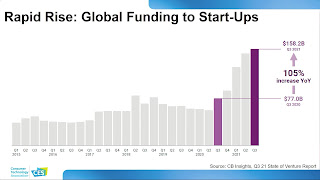
As CES opening talk says, the funding of startups has greatly increased over the past year, so that we can expect more image sensor startups funded:

Go to the original article...

Hyperspectral Sensor Startup Seetrum Raises "Hundreds of Millions of RMB" in Pre-A Round

Image Sensors World        Go to the original article...

Seetrum ( Chinese name Yuguang Technology) announces the completion of a pre-A round of financing of several hundred million yuan. Yuguang Technology focuses on providing spectroscopy chips,  AI algorithms and smart perception solutions.

Go to the original article...

Soitec Presents InP Integration onto Si Wafer for SWIR Sensing

Image Sensors World        Go to the original article...

Soitec Capital Market Day presentation shows the company's innovations in wafers for imaging:

Go to the original article...

EU Autovision Collaboration Targets Graphene SWIR Sensor for Automotive Applications

Image Sensors World        Go to the original article...

The AUTOVISION Spearhead Project aims to develop a graphene-based SWIR image sensor, and integrate it in a suitable camera system for self-driving cars.

Led by Qurv in Barcelona, AUTOVISION counts on the collaboration of industrial partners such Aixtron in the UK and Veoneer in Sweden, to help make safe deployment of autonomous vehicles possible.

The AUTOVISION project, over the course of three years, will produce CMOS graphene quantum dot image sensors in prototype sensor systems, ready for uptake in the automotive sector. Across the duration of the project, the developing image sensor is set to take huge leaps in sensitivity, operation speed and pixel size.


Once we talk about graphene and its applications, there is Vimeo lecture of Konstandtin Novoselvov, a co-recipient of Nobel Prize for graphene invention:


Go to the original article...

Hamamatsu "Lightsheet Readout"

Image Sensors World        Go to the original article...

Hamamatsu presents Lightsheet Readout Mode for microscopes that is said to improve image quality:

Go to the original article...

2021 in Review

Image Sensors World        Go to the original article...

Here is my list of the most significant achievements in image sensor industry this year:

Go to the original article...

In 2021, Smartsens Released 36 New Sensors to Mass Production, Completed 31 Tapeouts

Image Sensors World        Go to the original article...

Tencent, Sohu: Smartsens reports that in 2021 it has released 36 new products to mass production, and completed 31 tapeouts of future products including 4K and 8K image sensors for security and surveillance applications.

In a separate announcement, Smartsens presents its new automotive sensors: VGA SC031AP and 1MP SC101AP, both integrated with ISP and Tx output port:

Go to the original article...

Panasonic Analyses SPAD Quenching

Image Sensors World        Go to the original article...

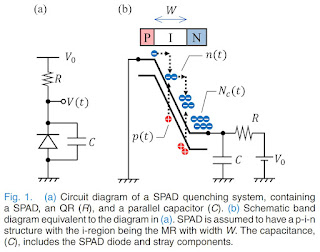
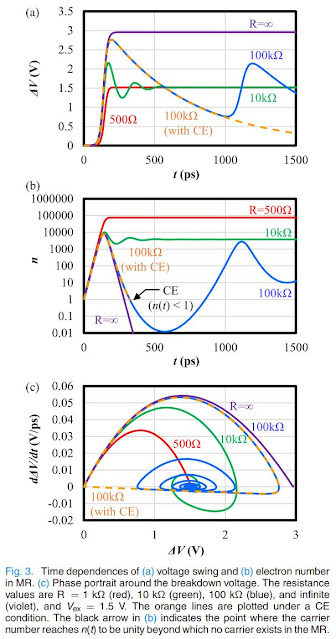
IEEE TED publishes Panasonic paper "Nonlinear Carrier Dynamics in a Single Photon Avalanche Diode: Stability, Bifurcation, and Quenching Condition" by Akito Inoue and Yutaka Hirose.

"Nonlinear carrier dynamics during quenching of a single photon avalanche diode (SPAD) are investigated. A Lienard type differential equation is derived from carrier continuity equations and it is solved analytically and numerically. Universal characteristics of the quenching carrier dynamics, i.e., stability, bifurcation, and quenching conditions, are analyzed on a trace-determinant plane of the Jacobian matrix and on a phase plane as functions of the quenching resistance (QR). With a finite QR or a resistive quenching (RQ), the breakdown voltage is found to be an attractor leading to a nonquenched final state. In order to produce a successful quenching, i.e., a status identified as an unstable fixed point (FP) with a zero-carrier state, two conditions are found to be necessary: 1) bias voltage dropping below breakdown voltage to ensure carrier decrease and 2) carrier extinction (CE) in this carrier decreasing period. The two conditions together lead to a threshold of QR. On the other hand, a capacitive quenching (CQ) appearing as a special case of RQ with an infinite resistance is found to show a completely different bifurcation character. CQ is derived to be equivalent to a logistic equation giving a transcritical bifurcation at the breakdown voltage and a final state identified as a stable FP with natural CE. Finally, two time constants both governed by an excess voltage are derived. In particular, one of them, a lifetime of impact ionizations, is found to be equivalent to the “avalanche frequency” of an impact ionization avalanche transit-time diode (IMPATT)."

Go to the original article...

Stratio Combines its SWIR Sensor with AI Algorithms to Detect Fakes

Image Sensors World        Go to the original article...

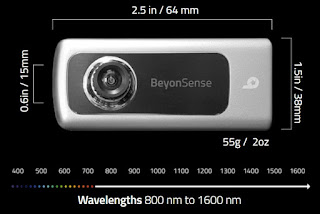
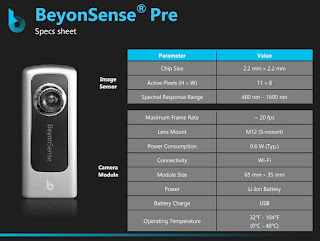
BusinessWireStratio will work with South Korea’s National IT Industry Promotion Agency (NIPA) to create a first-of-its kind app that detects design infringements. The app instantly matches photos of suspected items to similar designs from an IP database to obtain a similarity score. This is possible through a backend which utilizes several of Stratio's imaging technologies, including algorithms for object detection, image retrieval, and report generation.

"Using visible imaging technology with the help of AI is an important milestone in our technology roadmap,” explains James Lee, Co-founder and CEO of Stratio, Inc. “In terms of what's next for Stratio, Inc., we plan to merge this AI capability with our upcoming shortwave infrared (SWIR) camera BeyonSense to visualize the invisible, and open up a new world of possibilities using our proprietary SWIR image sensor.

Go to the original article...

CIS Companies Among Largest R&D Spenders in China

Image Sensors World        Go to the original article...

JW Insights publishes a list of top R&D spenders among semiconductor companies in China. Image sensor companies Will Semi (Omnivision) and Goodix take 3rd and 5th places respectively:


Goodix also pays one of the highest average salaries in China, according to another JW Insights report. Goodix average half-year salary is $45K in the first half of this year. This means that its average annual salary is $90K:


According to yet another JW Insights report, Will Semi is one of the most valuable companies among the mobile supply chain players in China:


JW Insights also ranks Will Semi the second in size among semiconductor companies in China:

Go to the original article...

More About Canon 3.2MP SPAD Sensor

Image Sensors World        Go to the original article...

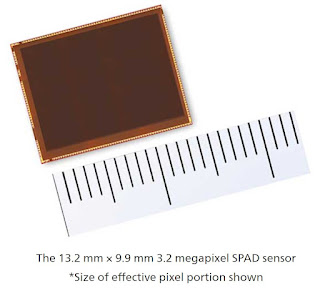
Canon publishes a press release about its SPAD sensor with 6.39 μm pixels presented at IEDM 2021:

"Canon Inc. announced today that the company, thanks to a proprietary pixel architecture that efficiently captures and greatly multiplies light, has successfully developed an ultra-small 13.2 mm x 9.9 mm SPAD sensor capable of capturing the world's highest1 resolution of 3.2-megapixel images—a higher resolution than Full HD (approximately 2.07 megapixels), even in low-light environments. Manufacture of the new sensor will commence in the second half of 2022.

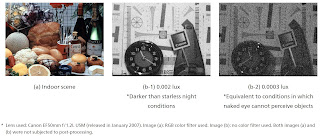
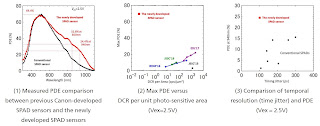
The newly developed SPAD sensor employs a proprietary pixel architecture that reflects photons inside the pixel in order to effectively detect photons across the entire range of the effective pixels. Under equivalent light, this SPAD sensor can capture the same images as a conventional CMOS sensor while requiring only 1/10 of imaging area. This makes possible an ultra-small design that can be installed even in small devices and greatly increases sensitivity, including for light on the near-infrared spectrum, and realizes video capture with 3.2 megapixels under low-light conditions of 0.002 lux—darker than a starless night sky. By equipping cameras designed for low-light and monitoring applications with this new SPAD sensor, even video footage of low-light environments can be viewed as if it were recorded in bright areas, enabling identification of subject movement as though viewing with the naked eye in well-lit environments

Beginning in the second half of 2022, Canon will commence manufacturing of SPAD sensors for use in the company's security-oriented network camera products. With the inclusion of this innovative sensor, Canon's products will gain a competitive edge and contribute to the realization of a more safe and secure society.

In addition, the SPAD sensor is capable of extremely high information processing speeds on the level of 100 ps (picoseconds, one-trillionth of a second), enabling it to capture objects moving at high speeds including photons. With a resolution that surpasses Full HD and high sensitivity that enables capture of faint light, the sensor's unique rapid response functionality can be utilized in a wide range of applications including self-driving vehicles, medical treatment, diagnostic imaging devices and scientific precision measuring instruments. Canon will proactively expand its sales network in order to encourage further innovation and development of society."

Go to the original article...

Huawei Unveils ISP with AI-based Low-Light Imaging Enhancement

Image Sensors World        Go to the original article...

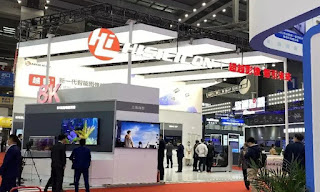
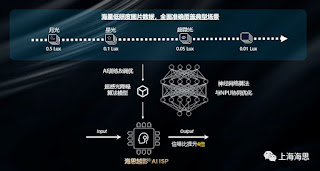
ITHome, GizomoChina, Huaweiupdate: Huawei semiconductor division HiSilicon presents its Yueying ISP at China International Social Public Safety Expo (China Security Expo for short).

"For the first time, the HiSilicon exhibition area fully revealed the five key capabilities of Yueying, breaking through the ceiling of traditional technology, enabling smarter and clearer picture quality in all scenes.

For the first time, HiSilicon moved the Dark Light Image Laboratory into the AMB Pavilion, allowing the public to experience the shocking effects of the latest black technology in an immersive manner. In the darkroom experience zone where “five fingers can't be seen”, one of Yueying’s key capabilities, super-sensitivity noise reduction, uses neural network deep learning to achieve intelligent noise reduction in low-light scenes, leading the industry in image quality and clarity. It also uses multi-spectral fusion technology to effectively fuse the visible light and infrared spectra, so that low-light images achieve a balance of color and detail, and reshape the colorful visual world."

Go to the original article...

Huawei Unveils ISP with AI-based Low-Light Imaging Enhancement

Image Sensors World        Go to the original article...

ITHome, GizomoChina, Huaweiupdate: Huawei semiconductor division HiSilicon presents its Yueying ISP at China International Social Public Safety Expo (China Security Expo for short).

"For the first time, the HiSilicon exhibition area fully revealed the five key capabilities of Yueying, breaking through the ceiling of traditional technology, enabling smarter and clearer picture quality in all scenes.

For the first time, HiSilicon moved the Dark Light Image Laboratory into the AMB Pavilion, allowing the public to experience the shocking effects of the latest black technology in an immersive manner. In the darkroom experience zone where “five fingers can't be seen”, one of Yueying’s key capabilities, super-sensitivity noise reduction, uses neural network deep learning to achieve intelligent noise reduction in low-light scenes, leading the industry in image quality and clarity. It also uses multi-spectral fusion technology to effectively fuse the visible light and infrared spectra, so that low-light images achieve a balance of color and detail, and reshape the colorful visual world."

Go to the original article...

Omnivision Milestones

Image Sensors World        Go to the original article...

Omnivision publishes a series of milestone videos summarizing the company's progress over the years:

Go to the original article...

Mobile Camera Module Prices in China in December 2021

Image Sensors World        Go to the original article...

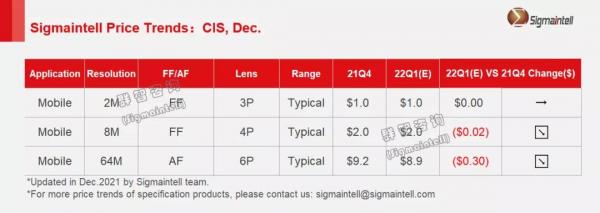
SigmaIntell publishes its report on camera module prices in China and its forecast for Q1 2022:


IThome quotes SigmaIntell (Chinese name Qunzhi Consulting):

"According to the latest survey data of Qunzhi Consulting in December, in terms of low-pixel products, 2M pixel products are affected by the strategic reduction in capacity supply. It is expected that prices in the first quarter will show a flat trend. 8M pixel products, affected by the previous price increase factors, the terminal demand will continue to be sluggish in the first quarter. Qunzhi Consulting predicts that the price will show a 3-5% decline in the first quarter .

In terms of high-pixel products, for 64M pixel products, upstream head chip vendors continue to increase their production capacity for high-pixel products, and the industry's high-pixel component inventory continues to increase. Inventory clearing has become a priority strategy for chip vendors in the current period, Qunzhi Consulting predicts , The price will show a decline of about 5% in the first quarter.

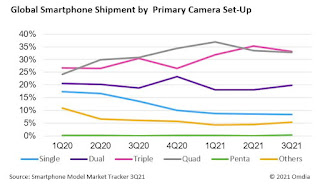
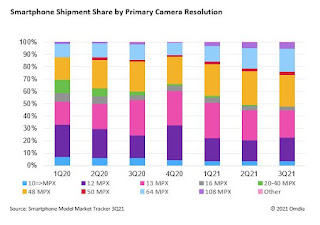
The trend of multiple cameras on smart phones will continue in the future. However, due to the diminishing marginal effect of the increase in the number of cameras on the improvement of photo effects, and the increase in the cost of mobile phones brought about by 5G, mobile phone manufacturers have slowed down the upgrade of cameras."

Omdia too publishes its analysis of smartphone cameras number and resolution trends:

Go to the original article...

Howard Rhodes Lifetime Achievement Memorial

Image Sensors World        Go to the original article...

Omnivision opens Howard Rhodes Lifetime Achievement Memorial Wall in its visitor center in Santa Clara, CA:

"As our former CTO & pioneer in CMOS sensor imaging industry, Howard created more than 200 issued US patent families and was one of the founders of OmniVision technology breakthroughs. This achievement wall not only honors Howard's contributions but also inspires #FutureInSight employees to innovate and achieve more accomplishments.

Furthermore, we have created “Howard Rhodes Award“ to honor our most outstanding engineer each year. Congratulations to Keiji Mabuchi who is the winner this year and Special thanks to Rhodes' Family who kindly shared Howard's plaque patents."

Keiji Mabuchi has 123 US issued patent families (274 granted US patents), not to talk about pending applications.

Go to the original article...

A3 on Recent Image Sensor Innovations

Image Sensors World        Go to the original article...

Association for Advancing Automation (A3) publishes its list of "Image Sensor Innovations that Push Machine Vision Forward."

  • ToF sensors:
    • Sony DepthSense BSI family
    • Teledyne e2v Hydra3D ToF CMOS
    • Teledyne e2v Flash series of image sensors for 3D laser triangulation
  • Prophesee event-based sensors
  • Sony IMX487 UV CMOS sensor
  • Sony SenSWIR sensors
  • SWIR Vision Systems CQD sensors
  • Emberion graphene SWIR sensor
  • Gpixel GMAX32103 CMOS sensor achieving 103.7MP resolution at 24fps frame rate

Go to the original article...

ST Promises SWIR Quantum Dot Pixel Future

Image Sensors World        Go to the original article...

ST publishes an article about its recent IEDM paper "1.62µm Global Shutter Quantum Dot Image Sensor Optimized for Near and Shortwave Infrared" by Johnathan Steckel:

"Quantum dots are tiny (between 2 nm to 20 nm usually) semiconductor crystals. One of their unique properties is that their optical and electrical properties change with their size. In an image sensor, using quantum dots of various sizes makes it possible to capture different wavelengths of light beyond silicon’s absorption limitations. In ST’s IEDM 2021 paper, researchers tuned quantum dots to capture 940 nm and 1400 nm light, the latter rivaling InGaAs sensors. However, InGaAs imaging devices are challenging and costly to make. Using a conventional 300 mm silicon wafer process in existing fabs, ST can produce the quantum dot sensor for shortwave infrared at a fraction of the cost.


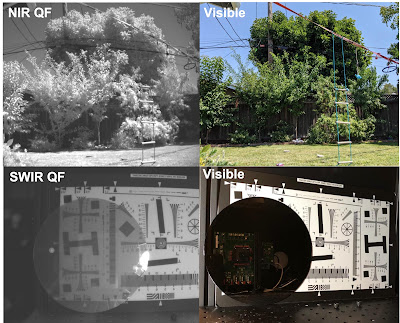
Images taken with our 940nm NIR QF sensor (top left) and with our 1400nm SWIR QF sensor (bottom left). Corresponding images taken using a visible smartphone camera (right). QF NIR image shows dramatically better contrast between black electrical wires hidden in the dark green leaves and tree trunks and branches hidden in front of the dark wood fence whereas the SWIR QF image shows how effective it is to use SWIR imaging to see through a Silicon wafer.

Quantum dots are not new, and scientists were already studying their properties in the early 1980s. However, it took years to colloidally synthesize crystals that could absorb infrared light and to create thin-film devices and fabrication processes that would yield the performance and stability necessary for real-world applications. More specifically, ST developed a manufacturing process that would not exceed 150ºC while also creating lithographic methodologies that would preserve the quantum dot’s integrity.


The IEDM 2021 paper explains in detail how ST created this image sensor technology on 300 mm wafers and describes the performance and reliability achieved to date. We plan to provide samples and evaluation kits to potential customers in 2022 and move to mass production in the coming years. Among the potential applications, mobile devices could use the new sensors to improve facial or object detection. Ultimately, a low-cost high-volume SWIR image sensor accessible to all consumers will open the door to new use-cases and applications."

Go to the original article...

Metasurface Photodetectors Review

Image Sensors World        Go to the original article...

MDPI publishes a review paper "Metasurface Photodetectors" by Jinzhao Li, Junyu Li, Shudao Zhou, and Fei Yi from Huazhong University of Science and Technology, National University of Defense Technology, and Raytron (China).

"Typical photodetectors only convert the intensity of light electrical output signals, leaving other electromagnetic parameters, such as the frequencies, phases, and polarization states unresolved. Metasurfaces are arrays of subwavelength structures that can manipulate the amplitude, phase, frequency, and polarization state of light. When combined with photodetectors, metasurfaces can enhance the light-matter interaction at the pixel level and also enable the detector pixels to resolve more electromagnetic parameters. In this paper, we review recent research efforts in merging metasurfaces with photodetectors towards improved detection performances and advanced detection schemes. The impacts of merging metasurfaces with photodetectors, on the architecture of optical systems, and potential applications are also discussed."

Go to the original article...

Gpixel Announces 9MP 1.1” NIR-enhanced Sensor for Intelligent Traffic Systems

Image Sensors World        Go to the original article...

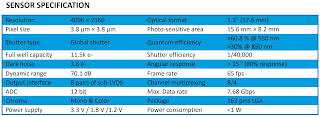
Gpixel announces GMAX3809 extending the GMAX family into ITS applications next to its traditional industrial inspection segment. Gpixel optimized the GMAX product architecture with dedicated ITS features such as enhanced NIR response, pixel size of 3.8 μm, LED flicker mitigation and multiple region HDR modes. GMAX3809 is first in a series of GMAX products with optimized product features for ITS applications.

GMAX3809 fits 4096(H) x 2160(V) (9 MP) resolution into a 1.1” format with low noise, charge domain Global Shutter pixels running at 65 fps at 12-bit ADC resolution. GMAX3809’s 3.8 μm pixel achieves a FWC of 11.5 Ke- and noise of 3.6 e- which delivers more than 70 dB linear DR. The peak QE is 60%, a Parasitic Light Sensitivity is -92 dB, and angular response at > 15° is 80%.

GMAX3809 comes standard in a NIR-enhanced version using Gpixel’s Red Fox technology, offering the ultimate balance between NIR sensitivity and MTF. GMAX3809 achieves a QE of more than 30% at 850 nm and 14% at 940 nm.

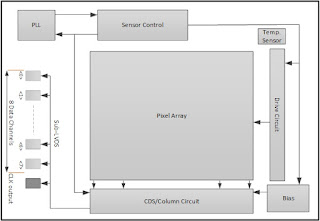
GMAX3809 delivers 65 fps with 8 pairs of sub-LVDS channels each running at 960 Mbps resulting in a maximum data rate of 7.68 Gbps. On-chip functions, such as on-chip color offset calibration, channel multiplexing, multiple region HDR and LED flicker are available and programmable through SPI or I2C interface.

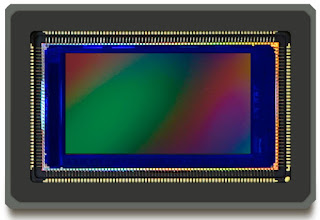
GMAX3809 is housed in a 163-pin ceramic LGA package with outer dimensions of 27.1 mm x 17.9 mm. The sensor assembly includes a double side AR coated cover glass lid.

GMAX3809 engineering samples can be ordered today for delivery in January, 2022.

Go to the original article...

BYD QVGA Sensor Won "China Chip" Excellent Market Performance Award

Image Sensors World        Go to the original article...

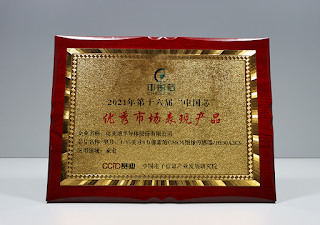
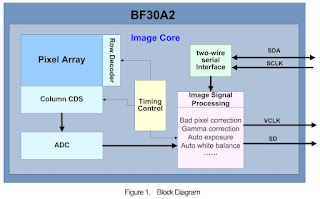
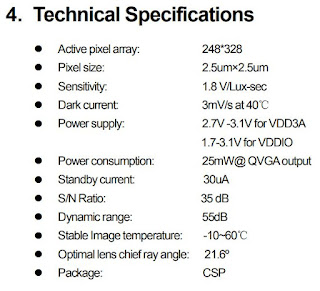
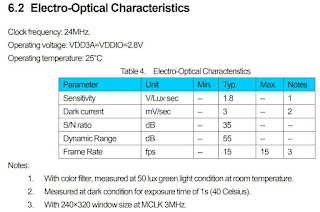
Sina Technology: BYD Semiconductor's 1/15-inch 80,000-pixel CMOS sensor BF30A2 won the 2021 "China Chip" product award for outstanding market performance in the field of home appliances.
The sensor has 2.5um 4T pixel and a maximum frame rate of 30fps. Its embedded ISP controls WB, AE, black level, filters out noise and false colors, removes dead pixels and dead pixel clusters, and  a skin color detection for more realistic skin color processing.

Since its launch in April 2020, BF30A2 has taken the lead in sales volume and applied for nearly 60 patents. It's said to have a market share of 85% in the wearable market.

Go to the original article...

css.php